Our Projects & Blog
A comprehensive overview of our engineering projects and latest news insights. Track our progress from conception to completion.
| Project ID | Project Name | Submission Date |
|---|---|---|
|
GT-RS-TR 24B-M08-03-2026
|
REPORT ON SUB - SOIL INVESTIGATION FOR THE PROPOSED A G+II STORIED RESIDENTIAL BUILDING FOR MR. BHIREN PAL, AT MOUZA: DUTTAPULIA, J.L. NO. 84, L.R. PLOT NO. 656, UNDER DUTTAPULIA (G.P) P.S. DHANTALA, BLOCK: RANAGHAT- II, DIST -NADIA, WEST BENGAL
|
Aug 11, 2026
|
|
GT-RS-TR 24A-M08-03-2026
|
REPORT ON SUB - SOIL INVESTIGATION FOR THE PROPOSED A G+II STORIED RESIDENTIAL BUILDING FOR MR. BHIREN PAL, AT MOUZA: DUTTAPULIA, J.L. NO. 84, L.R. PLOT NO. 656, UNDER DUTTAPULIA (G.P) P.S. DHANTALA, BLOCK: RANAGHAT- II, DIST -NADIA, WEST BENGAL
|
Aug 10, 2026
|
|
GT-RS-TR 20-M06-03-2026
|
REPORT ON SUB - SOIL INVESTIGATION FOR THE PROPOSED G+III STORIED RESIDENTIAL BUILDING AT PREMISES NO:- 29/3, KHAN MAHAMMAD ROAD, WARD NO:- 126, BOROUGH NO:- XVI, UNDER K.M.C. AT MOUZA - PASCHIM BARISHA, TOUZI NO:- 1-6, 8-10,12-16, J.L. NO:- 19, R.S. NO:-
|
Jun 30, 2026
|
|
GT-RS-TR13-M03-03-2026
|
SUB - SOIL INVESTIGATION FOR THE PROPOSED PROPOSED LG+G+IV AT JL NO 009 , MOUZA - BAMANPUKUR , PLOT NO - LR 1378,1379,1380 , KHATIAN NO :- LR 12203 UNDER MAYAPUR BAMANPUKUR-1 GP WITHIN NABADWIP BLOCK IN THE DISTRICT OF NADIA.
|
Mar 25, 2026
|
|
GT-RS-TR08-F02-04-2026
|
SUB - SOIL INVESTIGATION FOR THE PROPOSED LG+G+IV STORIED BUILDING AT PLOT. - 232,233,235 KHATIAN NO.- 3927 JL.- 13. MOUZAMOLLAPARA. BLOCK- NABADWIP
|
Feb 19, 2026
|
|
GT-RS-TR12-M03-02-2026
|
SUB - SOIL INVESTIGATION FOR THE PROPOSED LG+G+IV STORIED BUILDING AT JL NO 009 NO MAYAPUR BAMANPUKUR MOUZA, PLOT NO - LR 1371, KHATIAN NO - LR 4388 UNDER MAYAPUR BAMANPUKUR 1 GRAM PANCHAYAT WITHIN NABADWIP BLOCK, NADIA
|
Mar 24, 2026
|
|
GT-RS-TR 27-M08-06-2026
|
SUB - SOIL INVESTIGATION WORK FOR THE PROPOSED CONSTRUCTION OF (G+3) STORIED BUILDING AT PREMISES NO.-17E, MAHENDRA ROY LANE, WARD NO-59, P.S.- TOPSIA, KOLKATA - 700046, UNDER KOLKATA MUNICIPAL CORPORATION.
|
Aug 31, 2026
|
|
GT-RS-TR17-M05-02-2026
|
SOIL INVESTIGATION FOR THE PROPOSED THREE STORIED RESIDENTIAL BUILDING AT PREMISES NO - 1641, DAKSHIN BEHALA ROAD, WARD NO -125, BOROUGH NO - XVI, UNDER KMC. MOUZA - PASCHIM BARISHA, R.S. KHATIAN NO: - 1061, R.S. DAG NO: - 1368, TOUZI NO:- 1-6,8-10,12-16,
|
May 14, 2026
|
|
GT-RS-TR16-M04-02-2026
|
SOIL INVESTIGATION FOR THE PROPOSED (G+III) STORIED RESIDENTIAL BUILDING. AT PREMISES NO.- 13, DAKSHIN BEHALA ROAD, WARD NO - 126, BOROUGH NO - XVI, UNDER K.M.C, P.S.-THAKURPUKUR, DIST.-24 PGS.(S), KOLKATA - 700061. NAME OF CLIENT: SRI DIPAK DEY
|
Apr 07, 2026
|
|
TW-20-MD-11-05-26
|
SITE PLAN FAIRFEST MEDIA LTD 74/2, A.J.C. BOSE ROAD
|
May 11, 2026
|
|
KL Kundu Cement Works Smart Business Digital Setup
|
Complete Digital Transformation for KL Kundu Cement Works by Geocon Civil
|
Apr 15, 2026
|
|
GT-RS-101-04-2026
|
SOIL INVESTIGATION FOR THE PROPOSED MULTI-STORIED RESIDENTIAL BUILDING OWING THE POSITION OF R.S & L.R.S PLOT NO. 360 (P) KHATIAN NO: 7189, 7204 OF MOUZA-DUTTAPULIA J.L NO.84 UNDER DUTTAPULIA GRAMPANCHAYAT, NADIA.
|
Feb 19, 2026
|
|
TW-18-MD-09-05-26
|
FLAT MEASUREMENT AND SITE PLAN AT 94, SAHAPUR MAIN ROAD KOLKATA – 700038, WARD NO. 119, BOROUGH NO. 13, P.S. BEHALA
|
May 12, 2026
|
News & Insights
Read our latest articles on civil engineering and technology.

Why Soil Testing Is Important Even for G+2 and G+3 Buildings in Kolkata
A Small Story from Kolkata Imagine two neighbours in Kolkata, Mr. Sen and Mr. Roy. Both have small plots of land. Both want to build a G+3 residential building. Both have almost the same budget. Mr. Sen decides to start construction quickly. His contractor tells him, “Dada, this is only a G+3 building. The neighbouring houses are standing perfectly. Why spend extra money on a soil test?” Mr. Sen agrees. He starts the foundation work without testing the soil. Mr. Roy takes a different approach. Before starting construction, he consults a structural engineer. The engineer advises him to conduct a soil investigation. Mr. Roy asks, “Is a soil test really necessary for such a small building?” The engineer replies, “You can see the land, but you cannot see what is happening 10 or 15 feet below it. Your building will stand on that hidden ground for the next 50 years or more.” Mr. Roy understands the point and conducts the soil test. What Did the Soil Test Reveal? The investigation shows that the upper soil is relatively soft, with a stronger layer available at a greater depth. Based on the report, the structural engineer selects a suitable foundation system. Meanwhile, Mr. Sen's foundation was constructed mainly by following the dimensions used for another nearby building. A few years later, Mr. Sen notices cracks in some walls. One door also becomes difficult to close. Does this mean that his building is about to collapse? Not necessarily. But the cracks and door problems may be signs of foundation movement or uneven settlement. A proper structural inspection is required to identify the actual cause. Mr. Roy, on the other hand, has a foundation designed with knowledge of the soil conditions beneath his plot. This is an imaginary story, but the engineering lesson is very real. Why Is Soil Testing So Important in Kolkata? Kolkata has a complex soil profile. In many areas, the ground contains clay, silt, and other alluvial deposits. Some locations have filled-up land, old ponds, soft soil layers, or a high groundwater table. The important point is that soil conditions can change even between two nearby plots. A foundation that works well for one building may not be suitable for the building next door. This is why copying the foundation design of a neighbouring house is not a good engineering practice. What Does a Soil Test Tell Us? A soil investigation helps a structural engineer understand several important things: Soil Bearing Capacity: How much pressure the ground can safely support. Soil Layers: Whether the soil below the building is soft, medium, or relatively strong. Groundwater Level: Where groundwater is encountered and how it may affect foundation construction. Settlement: How much the foundation may move downward under the building load. Foundation Selection: Whether an isolated footing, combined footing, raft foundation, or pile foundation would be suitable. These details help the engineer design a foundation that is both safe and economical. But It Is Only a G+2 or G+3 Building! This is probably the most common question. People often think soil testing is required only for large apartment buildings or high-rise projects. But even a small G+3 building carries considerable weight. Think about the weight of RCC slabs, beams, columns, brick walls, flooring, furniture, water tanks, and people living inside the building. All these loads eventually travel down to the foundation and then into the soil. If the soil cannot support these loads properly, the building may experience excessive or uneven settlement. The ground does not know whether a building is G+2, G+3, or G+10. It only responds to the pressure applied to it. Is Soil Testing an Extra Expense? Suppose a family is spending ₹40–60 lakh to construct a house. They may spend money on expensive tiles, decorative ceilings, modular kitchens, and beautiful paint. But sometimes they hesitate to spend a relatively small amount on investigating the ground below the building. This is where priorities become important. Tiles can be replaced. Paint can be changed. Furniture can be repaired. But repairing a poorly designed foundation after construction may be difficult, disruptive, and expensive. Soil testing should therefore be considered an investment in the building's safety, not merely another construction expense. It may even save money by helping the engineer avoid unnecessarily large foundations where soil conditions are favourable. What Do Indian Engineering Standards Say? Indian Standards, including IS 1892 for subsurface investigation and IS 1904 for foundation design, provide guidance for investigating soil conditions and designing foundations. A proper investigation should be planned according to the type of building, its loads, and the local ground conditions. The number and depth of boreholes should be decided on engineering grounds, rather than assuming that the same testing arrangement will suit every plot. A Final Thought A building is not made safe simply by putting more steel into the columns or making the beams bigger. A building is a complete system. The slab transfers load to the beams. The beams transfer load to the columns. The columns transfer load to the foundation. And finally, the foundation transfers everything to the soil. If the ground beneath the foundation has not been properly understood, an important part of the structural design remains uncertain. Before building a G+2 or G+3 house in Kolkata, consult a qualified structural engineer and arrange a suitable soil investigation. A beautiful house is built above the ground. But a safe house begins below it.
Read Article
Your Neighbour's House Is Safe. But Is Yours?
Same Road. Same Building Height. Different Soil. Different Risk! Imagine two G+3 buildings standing next to each other in Kolkata. One building is perfectly fine. The other starts developing cracks in its walls after a few years. But why? Both buildings have four floors! The answer may be hidden beneath the ground. In Kolkata, soil conditions can change even within a short distance. One plot may have relatively firm soil, while the next may contain soft clay, filled-up pond soil, or a high groundwater table. And here's something every homeowner should understand: ❌ Your neighbour's foundation design is NOT your foundation design. A contractor might say, "Dada, pasher barite ei footing korechhe, apnar-o hoye jabe!" But structural engineering doesn't work that way. A proper foundation depends on: ✅ Actual soil conditions ✅ Building loads ✅ Safe bearing capacity ✅ Expected settlement ✅ Groundwater conditions ✅ Proper structural design More steel does not automatically mean more safety. A bigger footing does not automatically mean a better foundation. The right foundation is the one designed for the actual building and actual soil. Before spending lakhs on tiles, paint, and interior decoration, invest in understanding the ground that will support your home for decades. Remember: A beautiful building attracts attention. A properly engineered building protects lives. At GEOCON CIVIL, we believe that good construction begins with sound engineering decisions. 📍 Nabapally, Kolkata – 700104 🌐 www.geoconcivil.com 📞 70036 04231 GEOCON CIVIL — Building Confidence from the Ground Up.
Read Article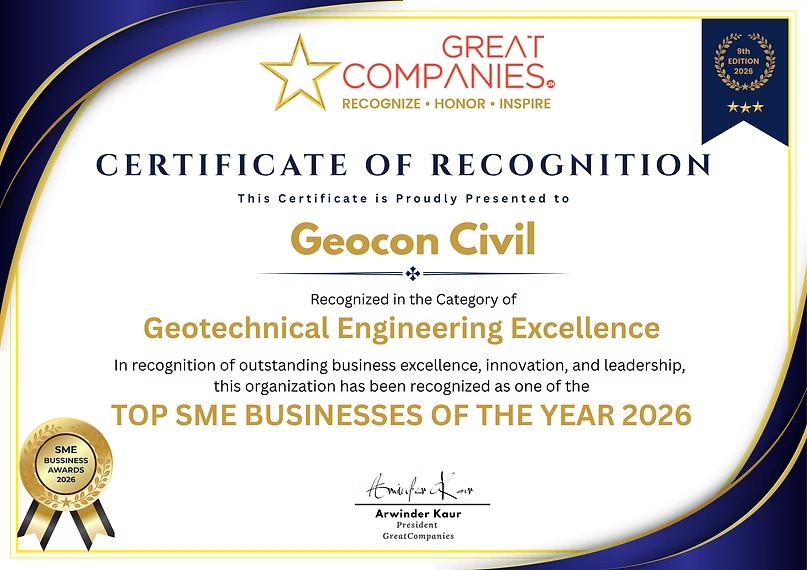
🏆 A Proud Milestone for GEOCON CIVIL!
Recognised for Geotechnical Engineering Excellence at the 9th Great Companies SME Business Awards 2026 We are delighted to share that GEOCON CIVIL, Kolkata, has been honoured with the Geotechnical Engineering Excellence Award and recognised among the Top SME Businesses of the Year 2026 by Great Companies. This recognition is more than an award. It represents our commitment to engineering accuracy, technical excellence, innovation, and safer construction practices. At GEOCON CIVIL, we believe that every strong structure begins with a proper understanding of the ground beneath it. From soil investigation and foundation recommendations to structural engineering and construction consultancy, our mission has always been simple: To deliver reliable engineering solutions that make construction safer, smarter, and more economical. Founded by Er. Rishav Singh, GEOCON CIVIL has grown through dedication, technical knowledge, and the trust of our valued clients. We sincerely thank Great Companies for this recognition, along with our clients, engineering associates, and everyone who has supported our journey. This achievement motivates us to continue improving, innovating, and contributing to the future of civil and geotechnical engineering. 🏆 Award: Geotechnical Engineering Excellence 🏅 Recognition: Top SME Businesses of the Year 2026 🏛️ Organiser: Great Companies – 9th SME Business Awards GEOCON CIVIL Building Confidence from the Ground Up. 📍 Nabapally, Kolkata – 700104 🌐 www.geoconcivil.com 📞 +91 70036 04231 📰 Read our official award feature: https://www.greatcompanies.in/post/geocon-civil-wins-the-geotechnical-engineering-excellence-award-at-the-9th-great-companies-sme-busin #GeoconCivil #GreatCompanies #SMEAwards2026 #AwardWinningCompany #GeotechnicalEngineering #CivilEngineering #SoilTesting #EngineeringExcellence #Kolkata #StructuralEngineering #IndianSME #BusinessExcellence
Read Article
Soil Testing in Kolkata: Building a Strong Foundation at Mahendra Roy Lane
Soil Testing in Kolkata: Building a Strong Foundation at Mahendra Roy Lane Geotechnical investigation for a proposed residential building in Topsia, Kolkata. Every strong building begins with understanding what lies beneath it. GEOCON-CIVIL recently conducted a comprehensive soil investigation for a proposed G+3 residential building at 17E, Mahendra Roy Lane, Topsia, Kolkata. Before construction begins, understanding the ground conditions is essential. Soil that appears stable at the surface may conceal weaker layers beneath, potentially affecting foundation performance and long-term structural stability. What Did Our Investigation Reveal? Our field investigation and laboratory testing identified varying soil conditions, including soft soil layers and organic deposits. These findings highlighted the importance of selecting an appropriate foundation system rather than relying on assumptions. Based on the investigation, foundation alternatives were examined to assist the structural engineer in selecting a suitable solution for the proposed building. Why Is Soil Testing Important Before Construction? Soil investigation helps engineers understand ground conditions, assess foundation requirements, evaluate settlement risks and make informed design decisions before construction begins. GEOCON-CIVIL: From Soil Investigation to Structural Solutions At GEOCON-CIVIL, we believe that informed engineering begins below ground level. Our geotechnical investigation services provide essential information for foundation planning, structural design and responsible construction. Whether planning a residential building, commercial development or building extension, understanding the soil is an important first step. Planning a construction project in Kolkata or West Bengal? Get in touch with GEOCON-CIVIL for professional soil investigation and civil engineering services. 7003604231 Contact GEOCON-CIVIL #Soil Testing in Kolkata | GEOCON-CIVIL Project #Discover how GEOCON-CIVIL conducted soil investigation for a residential building in Topsia, Kolkata, supporting informed foundation planning and safer construction.
Read Article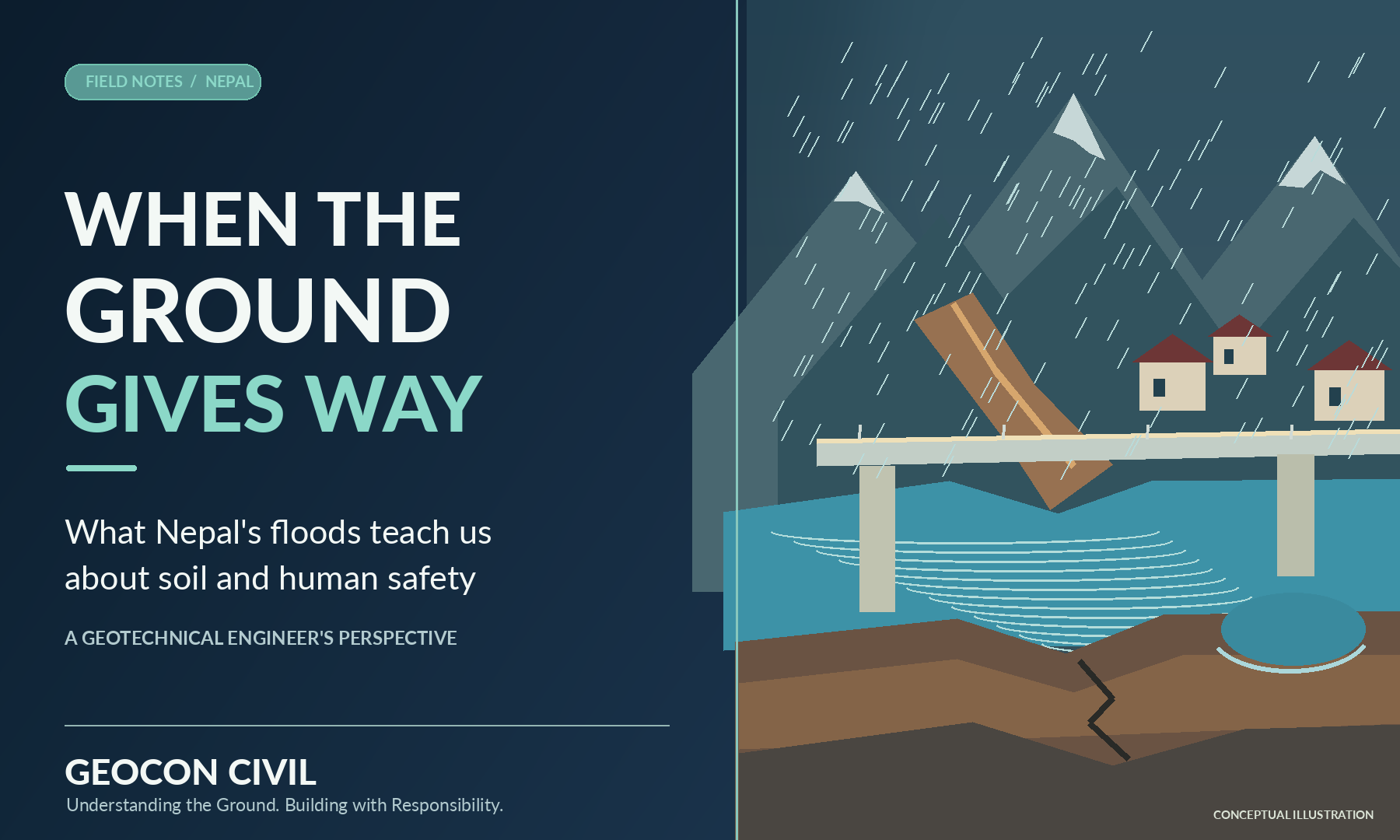
When the Ground Gives Way: What Nepal’s Floods Teach Us About Soil and Human Safety
When the Ground Gives Way: What Nepal’s Floods Teach Us About Soil and Human Safety A Geotechnical Engineer’s Perspective | Geocon Civil When floodwater enters a home, we see the damage. But beneath the water, something equally important may be happening: the soil supporting that home is changing. Nepal’s devastating floods remind us that a disaster is not always caused by water alone. Heavy rainfall can weaken hillsides, wash away the ground beneath bridges, damage roads and threaten building foundations. For a geotechnical engineer, these disasters raise an important question: What happens to the ground beneath our feet when it can no longer withstand the force of water? NEPAL’S FLOODS: A TRAGEDY BEYOND THE NUMBERS In September 2024, extreme rainfall caused devastating floods and landslides across Nepal. According to the United Nations, 246 people lost their lives, and 21 districts were affected, as reported on 8 October 2024. The World Bank subsequently estimated the economic damage at approximately NPR 46.7 billion. \(1, 2\) But behind every number was a family. A damaged road meant a child could not reach school. A collapsed bridge could leave an entire community isolated. A destroyed home meant a family had lost its shelter. According to the International Centre for Integrated Mountain Development (ICIMOD), rainfall exceeded 340 mm in less than three days at many locations across Kathmandu Valley. The rain fell on ground already saturated by earlier monsoon rainfall. \(3\) Much of the visible destruction involved water. Yet the behaviour of the ground beneath buildings, roads and hillsides was another critical part of the disaster. WHY DOES SOIL BECOME DANGEROUS DURING HEAVY RAINFALL? Soil is the natural foundation of almost everything we build. Under normal conditions, soil particles resist movement and support the weight of structures. However, prolonged rainfall allows water to enter the spaces between soil particles. When water pressure increases inside the ground, certain soils can lose some of their ability to resist movement. Imagine a hillside that has remained stable for decades. After several days of continuous rainfall, water gradually accumulates inside its soil layers. If the forces pulling the soil downhill become greater than the forces holding it in place, a landslide may occur. This explains why a hillside that appears safe during normal weather can become dangerous after prolonged rainfall. Nepal’s disaster reminds us that soil stability is not permanent. It can change with rainfall, groundwater conditions, erosion and human activities. WHEN A STRONG BRIDGE LOSES ITS FOUNDATION A bridge may have strong concrete and steel, but its safety also depends on the ground supporting it. During floods, fast-moving water can remove soil and sediment from around bridge foundations. Engineers call this process scour. When too much supporting material disappears, the foundation may lose support, settle or experience excessive movement. The structure above may remain strong, but the ground beneath it may no longer provide adequate support. The World Bank estimated that the September 2024 floods caused approximately NPR 28 billion in road damage and NPR 1 billion in bridge damage. These figures represent overall infrastructure losses, not damage attributed exclusively to foundation failures. \(2\) The engineering lesson is simple: A bridge must be designed not only for the river we see today but also for the riverbed conditions that may develop during extreme flooding. THE HIDDEN DANGER BENEATH OUR HOMES Floodwater does not always need to enter a building to damage it. Flowing water can erode soil beside a foundation. Rising groundwater can change the behaviour of certain soil deposits. Weak or disturbed ground may lead to settlement, cracks or tilting. Imagine a family returning home after the floodwater disappears. Their walls are still standing. The roof is intact. Everything looks almost normal. But is the soil beneath the foundation still safe? That question cannot always be answered through visual observation alone. Buildings showing new cracks, tilting, exposed foundations or unusual settlement after flooding should be assessed by qualified engineers before being occupied again. A standing building is not automatically a safe building. WHAT CAN A GEOTECHNICAL ENGINEER DO? A geotechnical engineer studies the ground beneath buildings, roads, bridges and other structures. The objective is to understand how soil behaves under different loading, rainfall and groundwater conditions. Soil investigation helps identify weak soil layers, groundwater levels and potential foundation problems. Standard Penetration Tests (SPT), borehole investigations and laboratory tests provide valuable information about the ground. Slope stability studies help engineers assess whether a hillside may become unstable during prolonged rainfall. Foundation design considers soil strength, expected settlement and possible erosion. Drainage systems help control water accumulation around vulnerable slopes and structures. After a flood, geotechnical investigations can help determine whether damaged ground is suitable for reconstruction or requires additional treatment. These engineering activities cannot prevent every natural disaster. However, they can help reduce avoidable risks when combined with proper planning, construction, maintenance and early warning systems. A LESSON FOR INDIA AND THE HIMALAYAN REGION Nepal’s experience carries important lessons for India, particularly the Himalayan foothills, West Bengal and other flood-prone regions. In mountainous areas, engineers must pay particular attention to slope stability, rainfall infiltration and landslides. In river plains, soil erosion, weak deposits, groundwater changes and foundation settlement may become important concerns. Every construction site has different ground conditions. A soil investigation carried out at one location cannot automatically establish the safety of another location. Similarly, a soil report prepared before a major flood may require reassessment if significant erosion, deposition, groundwater changes or ground movement have occurred. ICIMOD highlighted how unplanned construction, development on floodplains and inadequate drainage aggravated the September 2024 flooding in Kathmandu. \(3\) This reminds us that safer construction requires understanding not only the building itself but also the surrounding land, rivers and natural drainage systems. OUR MESSAGE FROM GEOCON CIVIL At Geocon Civil, we believe that soil investigation is not merely a technical requirement before construction. It is an opportunity to understand the ground on which human lives and investments depend. The tragedy in Nepal reminds us why this work matters. Behind every foundation is a family expecting safety. Behind every bridge is a community depending on connection. Behind every soil test is an engineering decision that may affect human lives. We cannot control the rain, and we cannot promise that every natural disaster can be prevented. But we can investigate the ground carefully, understand its limitations and design structures with greater awareness of the risks. Before we build higher, we must understand what lies deeper. And before we rebuild after a disaster, we must ask whether the ground is ready to support us again. GEOCON CIVIL REFERENCES (1) United Nations Nepal (8 October 2024). Press release on the humanitarian response to Nepal’s September 2024 floods and landslides. (2) World Bank (April 2025). Nepal Development Update, Box 1: September 2024 Floods. (3) International Centre for Integrated Mountain Development (28 September 2024). Press release on Nepal’s torrential rainfall, flooding and development-related vulnerabilities.
Read Article
Before Buying a Flat, Check the Measurement First!
Recently, GeoCon Civil completed professional measurement and site plan work for a flat, parking space, and servant quarter at Raj Roshni Building, Kolkata – 700038, Ward No. 119, Borough No. 13, P.S. Behala, under Kolkata Municipal Corporation. The work included: ✔ Flat measurement ✔ Parking space verification ✔ Servant quarter measurement ✔ Carpet area checking ✔ Site verification ✔ Engineering site plan preparation ✔ Proper documentation Nowadays, many people buy flats by seeing beautiful interiors, paint, lighting, and decoration. But very few people check the actual area they are getting. And this small mistake can cost lakhs of rupees. Sometimes the area written on paper and the actual usable area are not the same. Many buyers understand this only after payment and registration. If your flat area is even 50 sq ft less, and the price is ₹10,000 per sq ft, your loss becomes ₹5 lakh. That is why professional measurement is very important before purchasing any property. A proper engineering measurement helps you: • Know the actual area • Verify parking dimensions • Avoid future disputes • Check builder claims • Protect your hard-earned money At GeoCon Civil, every work is done with proper engineering accuracy, honesty, and professional documentation. Because buying a property is one of the biggest investments in life. “Measure first. Then invest.” GeoCon Civil By Er. Rishav Singh LBS Class-I Civil Engineer Kolkata Municipal Corporation
Read Article
Planning to Build in Kolkata? Here’s Why KMC Approval and Soil Testing Matter More Than You Think
Planning to Build in Kolkata? Here’s Why KMC Approval and Soil Testing Matter More Than You Think Building your dream home or starting a new construction project is exciting. But before the bricks, concrete, and design work begin, there are two important things every property owner should focus on — proper KMC approval and soil testing. Many people invest heavily in construction without understanding the condition of the land beneath the building. Others begin work without completing the required approval process. These small mistakes can later lead to serious structural issues, legal complications, delays, and unexpected expenses. That is why professional engineering guidance is important from the very beginning. At GEOCON CIVIL we help property owners, builders, and developers across Kolkata with complete civil engineering and geotechnical support — from KMC LBS approval to soil testing and foundation recommendations. Why KMC LBS Approval is Necessary Before Construction Before starting construction within KMC areas, your building plan must follow municipal rules and safety regulations. A licensed KMC LBS engineer helps ensure that your project is properly planned and approved. Without approval, many people later face: Delays in construction Problems during property registration Municipal objections Penalty notices Difficulty getting utility connections A professionally prepared sanction plan saves both time and future trouble. At GEOCON CIVIL we guide clients through the complete approval process in a simple and professional way, making the process faster and smoother. Soil Testing: The Step Most People Ignore One of the biggest mistakes in construction is skipping soil testing to save money or time. But the truth is simple — every building stands on soil, and not every soil can safely carry the same load. Some areas may have soft soil, high groundwater, loose filling, or settlement issues. Without proper investigation, the foundation may not perform safely over time. Professional soil testing helps engineers understand: The strength of the ground Safe bearing capacity of soil Suitable foundation depth Water table condition Settlement risk of the structure This information becomes the base for safe structural design. In simple words, a strong building always begins below the ground level. Why Geotechnical Investigation is Important A geotechnical investigation is not just a technical report. It is a safety check for your future building. Whether you are planning: A residential house Apartment building Commercial property Multistorey structure Industrial project soil investigation helps reduce future construction risks and unnecessary expenses. At GEOCON CIVIL we provide: Soil testing services in Kolkata Bore log report preparation Foundation recommendations Land and flat measurement Structural planning and consultancy Our goal is to provide practical engineering solutions that are safe, accurate, and reliable. Choosing the Right Engineering Support Makes a Difference Construction projects involve significant investment. A small technical mistake during planning can create major problems later. That is why working with experienced civil and geotechnical professionals is important. At GEOCON CIVIL, we focus on: Honest technical guidance Accurate reporting Timely support Professional consultation Safe and economical engineering solutions Under the guidance of Er. Rishav Singh, the company continues to support modern construction projects with practical civil engineering expertise and geotechnical knowledge. Build Smart. Build Safe. Before starting your next construction project, make sure your building stands on a properly investigated foundation and follows all required approval procedures. Good construction is not only about design and appearance — it is about safety, planning, and engineering accuracy. If you are searching for: Soil testing in Kolkata KMC LBS engineer near me Building plan approval Geotechnical investigation services Foundation recommendation consultant then GEOCON CIVIL is ready to assist you with professional support. Contact GEOCON CIVIL 📞 Call/WhatsApp: +91 70036 04231
Read Article
Transforming Traditional Manufacturing Through Digital Innovation: The KL Kundu Cement Works Success Story
In an era where industries are rapidly transitioning toward technology-driven operations, digital transformation has become a strategic necessity rather than an option. Businesses involved in manufacturing and infrastructure development are increasingly recognizing the importance of establishing a strong digital presence to improve operational efficiency, enhance credibility, and remain competitive in a modern marketplace. Understanding this evolving landscape, Geocon Civil successfully delivered a complete Smart Business Digital Setup solution for KL Kundu Cement Works https://www.klkunducementworks.com/ — a registered MSME unit specializing in the manufacturing of R.C.C. Hume Pipes and Collars. This project stands as a strong example of how traditional industrial businesses can successfully integrate modern digital systems to strengthen their brand identity, operational communication, and customer accessibility. About KL Kundu Cement Works KL Kundu Cement Works is a trusted manufacturer and government contractor engaged in producing high-quality R.C.C. Hume Pipes and precision-engineered collars for infrastructure and drainage applications. The company is known for delivering durable, industry-compliant products while maintaining competitive pricing, timely execution, and reliable site delivery. With manufacturing expertise supported by advanced production methods such as centrifugal spinning technology, the company serves a wide range of infrastructure requirements across both public and private sectors. Their product range includes: * R.C.C. Hume Pipes * R.C.C. Collars * NP2, NP3 & NP4 classification products under IS: 458 standards * Sizes ranging from 150mm to 1800mm diameter * S/S and F/J joint systems for diverse engineering applications The organization’s commitment to quality, integrity, and dependable service has helped establish long-term client relationships built on trust and performance. The Need for Digital Transformation Despite strong manufacturing capabilities and a reliable market presence, KL Kundu Cement Works required a professional digital infrastructure that could accurately represent the company’s industrial capabilities in the online environment. The primary goals included: * Establishing a professional online identity * Increasing market visibility * Improving digital communication * Showcasing products and technical specifications professionally * Creating a scalable digital platform for future growth * Strengthening brand credibility among clients and contractors Geocon Civil approached the project with a strategy focused on creating a complete digital ecosystem rather than simply designing a website. Geocon Civil’s Smart Business Digital Setup Solution As part of its expanding Smart Business Digital Setup services, Geocon Civil developed and implemented a comprehensive digital framework tailored specifically for the operational and branding needs of KL Kundu Cement Works. A modern, responsive, and SEO-optimized corporate website was designed and developed to represent the company professionally in the digital space. The website includes: * Professional corporate presentation * Detailed product showcase * Technical specification sections * Service and manufacturing capabilities * Project gallery integration * Mobile-responsive design * Fast-loading architecture * User-friendly navigation system * Contact and inquiry management integration The digital platform now acts as the company’s online corporate identity, allowing clients, contractors, and organizations to access business information efficiently from anywhere. Digital Branding & Business Positioning Geocon Civil strategically structured the website content and digital presentation to reflect: * Industrial professionalism * Engineering credibility * Manufacturing expertise * Government contracting capabilities * Technical reliability * Long-term business stability The digital branding strategy was developed to align with modern industry expectations while maintaining the company’s traditional values of trust, quality, and commitment. Strengthening Industrial Presence Through Technology One of the most significant aspects of this project was the transformation of a traditional manufacturing business into a digitally accessible and professionally positioned industrial brand. The implementation delivered several advantages: * Enhanced online visibility * Improved customer accessibility * Professional digital identity * Better product presentation * Increased business credibility * Future-ready digital infrastructure * Stronger communication capabilities The digital transformation now enables KL Kundu Cement Works to engage with clients more effectively while supporting long-term operational scalability. Engineering Meets Digital Innovation Geocon Civil’s role in this project demonstrates its vision of integrating engineering excellence with advanced digital solutions. While traditionally recognized for civil engineering and consultancy services, Geocon Civil is also emerging as a technology-driven infrastructure solutions provider focused on helping businesses modernize through digital systems. The successful execution of the KL Kundu Cement Works project reflects Geocon Civil’s capability in: * Smart business infrastructure development * Industrial website solutions * Digital workflow integration * Professional branding systems * Technology-enabled business transformation Building the Future Beyond Physical Infrastructure Modern infrastructure is no longer limited to physical construction alone. Digital infrastructure now plays an equally important role in determining a company’s growth, visibility, and operational effectiveness. The KL Kundu Cement Works project represents a new generation of industrial modernization where traditional manufacturing businesses embrace digital technology to improve performance, reach wider markets, and establish stronger professional identities. Through this successful implementation, Geocon Civil continues to demonstrate its commitment to delivering innovative, scalable, and future-ready business solutions designed for the evolving industrial landscape. Businesses that invest in digital transformation today are building stronger foundations for tomorrow — and Geocon Civil is helping make that transformation possible. Mr. Biplab Samanta Head – IT & Digital Solutions Geocon Civil
Read ArticleWant to start a new project with us?
Our expert team is ready to assist you with premium consultancy and tech solutions.
Get in Touch