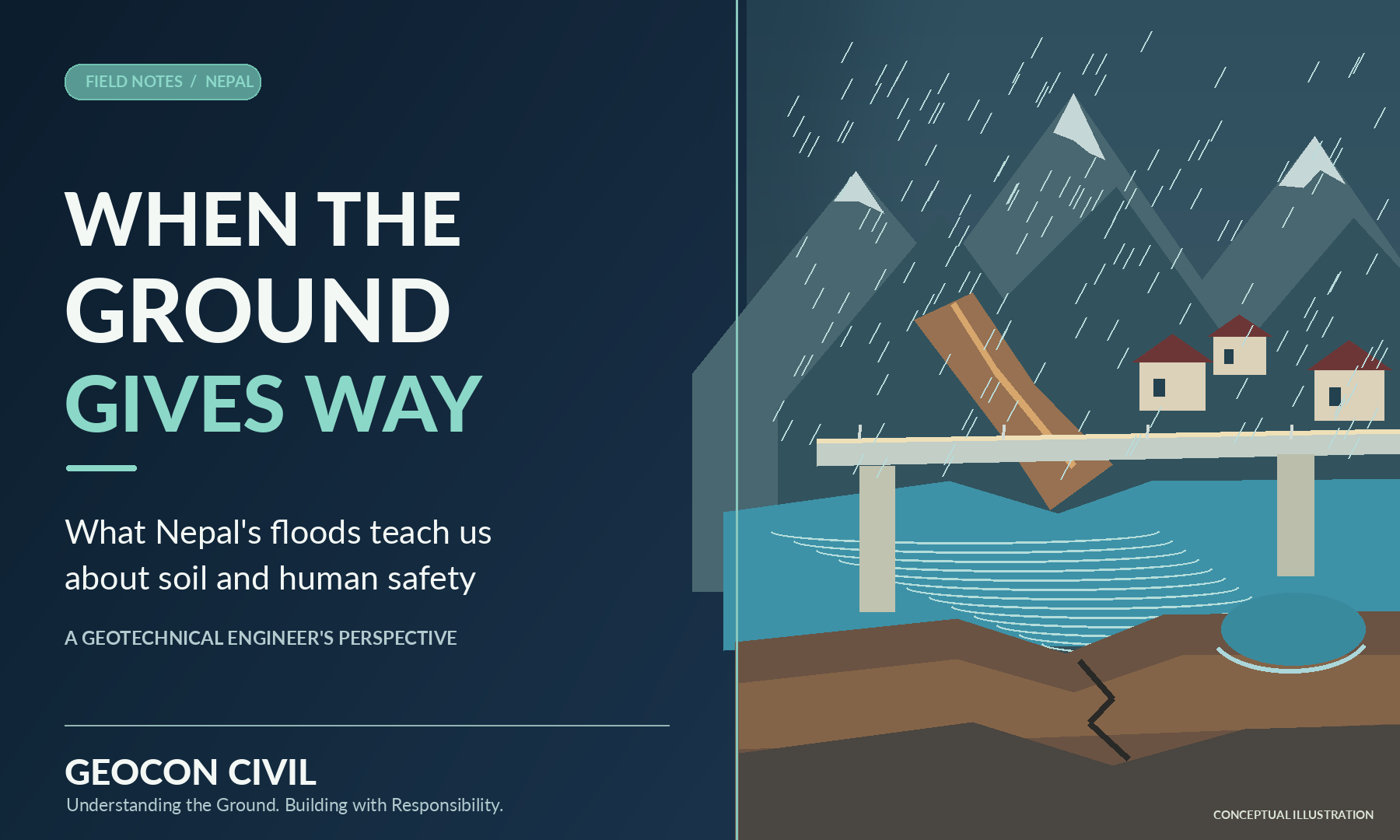
When the Ground Gives Way: What Nepal’s Floods Teach Us About Soil and Human Safety
A Geotechnical Engineer’s Perspective | Geocon Civil
When floodwater enters a home, we see the damage. But beneath the water, something equally important may be happening: the soil supporting that home is changing.
Nepal’s devastating floods remind us that a disaster is not always caused by water alone. Heavy rainfall can weaken hillsides, wash away the ground beneath bridges, damage roads and threaten building foundations.
For a geotechnical engineer, these disasters raise an important question: What happens to the ground beneath our feet when it can no longer withstand the force of water?
NEPAL’S FLOODS: A TRAGEDY BEYOND THE NUMBERS
In September 2024, extreme rainfall caused devastating floods and landslides across Nepal.
According to the United Nations, 246 people lost their lives, and 21 districts were affected, as reported on 8 October 2024. The World Bank subsequently estimated the economic damage at approximately NPR 46.7 billion. \(1, 2\)
But behind every number was a family.
A damaged road meant a child could not reach school. A collapsed bridge could leave an entire community isolated. A destroyed home meant a family had lost its shelter.
According to the International Centre for Integrated Mountain Development (ICIMOD), rainfall exceeded 340 mm in less than three days at many locations across Kathmandu Valley. The rain fell on ground already saturated by earlier monsoon rainfall. \(3\)
Much of the visible destruction involved water. Yet the behaviour of the ground beneath buildings, roads and hillsides was another critical part of the disaster.
WHY DOES SOIL BECOME DANGEROUS DURING HEAVY RAINFALL?
Soil is the natural foundation of almost everything we build.
Under normal conditions, soil particles resist movement and support the weight of structures. However, prolonged rainfall allows water to enter the spaces between soil particles.
When water pressure increases inside the ground, certain soils can lose some of their ability to resist movement.
Imagine a hillside that has remained stable for decades.
After several days of continuous rainfall, water gradually accumulates inside its soil layers. If the forces pulling the soil downhill become greater than the forces holding it in place, a landslide may occur.
This explains why a hillside that appears safe during normal weather can become dangerous after prolonged rainfall.
Nepal’s disaster reminds us that soil stability is not permanent. It can change with rainfall, groundwater conditions, erosion and human activities.
WHEN A STRONG BRIDGE LOSES ITS FOUNDATION
A bridge may have strong concrete and steel, but its safety also depends on the ground supporting it.
During floods, fast-moving water can remove soil and sediment from around bridge foundations. Engineers call this process scour.
When too much supporting material disappears, the foundation may lose support, settle or experience excessive movement.
The structure above may remain strong, but the ground beneath it may no longer provide adequate support.
The World Bank estimated that the September 2024 floods caused approximately NPR 28 billion in road damage and NPR 1 billion in bridge damage. These figures represent overall infrastructure losses, not damage attributed exclusively to foundation failures. \(2\)
The engineering lesson is simple: A bridge must be designed not only for the river we see today but also for the riverbed conditions that may develop during extreme flooding.
THE HIDDEN DANGER BENEATH OUR HOMES
Floodwater does not always need to enter a building to damage it.
Flowing water can erode soil beside a foundation. Rising groundwater can change the behaviour of certain soil deposits. Weak or disturbed ground may lead to settlement, cracks or tilting.
Imagine a family returning home after the floodwater disappears.
Their walls are still standing. The roof is intact. Everything looks almost normal.
But is the soil beneath the foundation still safe?
That question cannot always be answered through visual observation alone.
Buildings showing new cracks, tilting, exposed foundations or unusual settlement after flooding should be assessed by qualified engineers before being occupied again.
A standing building is not automatically a safe building.
WHAT CAN A GEOTECHNICAL ENGINEER DO?
A geotechnical engineer studies the ground beneath buildings, roads, bridges and other structures.
The objective is to understand how soil behaves under different loading, rainfall and groundwater conditions.
Soil investigation helps identify weak soil layers, groundwater levels and potential foundation problems.
Standard Penetration Tests (SPT), borehole investigations and laboratory tests provide valuable information about the ground.
Slope stability studies help engineers assess whether a hillside may become unstable during prolonged rainfall.
Foundation design considers soil strength, expected settlement and possible erosion.
Drainage systems help control water accumulation around vulnerable slopes and structures.
After a flood, geotechnical investigations can help determine whether damaged ground is suitable for reconstruction or requires additional treatment.
These engineering activities cannot prevent every natural disaster. However, they can help reduce avoidable risks when combined with proper planning, construction, maintenance and early warning systems.
A LESSON FOR INDIA AND THE HIMALAYAN REGION
Nepal’s experience carries important lessons for India, particularly the Himalayan foothills, West Bengal and other flood-prone regions.
In mountainous areas, engineers must pay particular attention to slope stability, rainfall infiltration and landslides.
In river plains, soil erosion, weak deposits, groundwater changes and foundation settlement may become important concerns.
Every construction site has different ground conditions.
A soil investigation carried out at one location cannot automatically establish the safety of another location.
Similarly, a soil report prepared before a major flood may require reassessment if significant erosion, deposition, groundwater changes or ground movement have occurred.
ICIMOD highlighted how unplanned construction, development on floodplains and inadequate drainage aggravated the September 2024 flooding in Kathmandu. \(3\)
This reminds us that safer construction requires understanding not only the building itself but also the surrounding land, rivers and natural drainage systems.
OUR MESSAGE FROM GEOCON CIVIL
At Geocon Civil, we believe that soil investigation is not merely a technical requirement before construction. It is an opportunity to understand the ground on which human lives and investments depend.
The tragedy in Nepal reminds us why this work matters.
Behind every foundation is a family expecting safety.
Behind every bridge is a community depending on connection.
Behind every soil test is an engineering decision that may affect human lives.
We cannot control the rain, and we cannot promise that every natural disaster can be prevented.
But we can investigate the ground carefully, understand its limitations and design structures with greater awareness of the risks.
Before we build higher, we must understand what lies deeper.
And before we rebuild after a disaster, we must ask whether the ground is ready to support us again.
GEOCON CIVIL
REFERENCES
(1) United Nations Nepal (8 October 2024). Press release on the humanitarian response to Nepal’s September 2024 floods and landslides.
(2) World Bank (April 2025). Nepal Development Update, Box 1: September 2024 Floods.
(3) International Centre for Integrated Mountain Development (28 September 2024). Press release on Nepal’s torrential rainfall, flooding and development-related vulnerabilities.
A Geotechnical Engineer’s Perspective | Geocon Civil
When floodwater enters a home, we see the damage. But beneath the water, something equally important may be happening: the soil supporting that home is changing.
Nepal’s devastating floods remind us that a disaster is not always caused by water alone. Heavy rainfall can weaken hillsides, wash away the ground beneath bridges, damage roads and threaten building foundations.
For a geotechnical engineer, these disasters raise an important question: What happens to the ground beneath our feet when it can no longer withstand the force of water?
NEPAL’S FLOODS: A TRAGEDY BEYOND THE NUMBERS
In September 2024, extreme rainfall caused devastating floods and landslides across Nepal.
According to the United Nations, 246 people lost their lives, and 21 districts were affected, as reported on 8 October 2024. The World Bank subsequently estimated the economic damage at approximately NPR 46.7 billion. \(1, 2\)
But behind every number was a family.
A damaged road meant a child could not reach school. A collapsed bridge could leave an entire community isolated. A destroyed home meant a family had lost its shelter.
According to the International Centre for Integrated Mountain Development (ICIMOD), rainfall exceeded 340 mm in less than three days at many locations across Kathmandu Valley. The rain fell on ground already saturated by earlier monsoon rainfall. \(3\)
Much of the visible destruction involved water. Yet the behaviour of the ground beneath buildings, roads and hillsides was another critical part of the disaster.
WHY DOES SOIL BECOME DANGEROUS DURING HEAVY RAINFALL?
Soil is the natural foundation of almost everything we build.
Under normal conditions, soil particles resist movement and support the weight of structures. However, prolonged rainfall allows water to enter the spaces between soil particles.
When water pressure increases inside the ground, certain soils can lose some of their ability to resist movement.
Imagine a hillside that has remained stable for decades.
After several days of continuous rainfall, water gradually accumulates inside its soil layers. If the forces pulling the soil downhill become greater than the forces holding it in place, a landslide may occur.
This explains why a hillside that appears safe during normal weather can become dangerous after prolonged rainfall.
Nepal’s disaster reminds us that soil stability is not permanent. It can change with rainfall, groundwater conditions, erosion and human activities.
WHEN A STRONG BRIDGE LOSES ITS FOUNDATION
A bridge may have strong concrete and steel, but its safety also depends on the ground supporting it.
During floods, fast-moving water can remove soil and sediment from around bridge foundations. Engineers call this process scour.
When too much supporting material disappears, the foundation may lose support, settle or experience excessive movement.
The structure above may remain strong, but the ground beneath it may no longer provide adequate support.
The World Bank estimated that the September 2024 floods caused approximately NPR 28 billion in road damage and NPR 1 billion in bridge damage. These figures represent overall infrastructure losses, not damage attributed exclusively to foundation failures. \(2\)
The engineering lesson is simple: A bridge must be designed not only for the river we see today but also for the riverbed conditions that may develop during extreme flooding.
THE HIDDEN DANGER BENEATH OUR HOMES
Floodwater does not always need to enter a building to damage it.
Flowing water can erode soil beside a foundation. Rising groundwater can change the behaviour of certain soil deposits. Weak or disturbed ground may lead to settlement, cracks or tilting.
Imagine a family returning home after the floodwater disappears.
Their walls are still standing. The roof is intact. Everything looks almost normal.
But is the soil beneath the foundation still safe?
That question cannot always be answered through visual observation alone.
Buildings showing new cracks, tilting, exposed foundations or unusual settlement after flooding should be assessed by qualified engineers before being occupied again.
A standing building is not automatically a safe building.
WHAT CAN A GEOTECHNICAL ENGINEER DO?
A geotechnical engineer studies the ground beneath buildings, roads, bridges and other structures.
The objective is to understand how soil behaves under different loading, rainfall and groundwater conditions.
Soil investigation helps identify weak soil layers, groundwater levels and potential foundation problems.
Standard Penetration Tests (SPT), borehole investigations and laboratory tests provide valuable information about the ground.
Slope stability studies help engineers assess whether a hillside may become unstable during prolonged rainfall.
Foundation design considers soil strength, expected settlement and possible erosion.
Drainage systems help control water accumulation around vulnerable slopes and structures.
After a flood, geotechnical investigations can help determine whether damaged ground is suitable for reconstruction or requires additional treatment.
These engineering activities cannot prevent every natural disaster. However, they can help reduce avoidable risks when combined with proper planning, construction, maintenance and early warning systems.
A LESSON FOR INDIA AND THE HIMALAYAN REGION
Nepal’s experience carries important lessons for India, particularly the Himalayan foothills, West Bengal and other flood-prone regions.
In mountainous areas, engineers must pay particular attention to slope stability, rainfall infiltration and landslides.
In river plains, soil erosion, weak deposits, groundwater changes and foundation settlement may become important concerns.
Every construction site has different ground conditions.
A soil investigation carried out at one location cannot automatically establish the safety of another location.
Similarly, a soil report prepared before a major flood may require reassessment if significant erosion, deposition, groundwater changes or ground movement have occurred.
ICIMOD highlighted how unplanned construction, development on floodplains and inadequate drainage aggravated the September 2024 flooding in Kathmandu. \(3\)
This reminds us that safer construction requires understanding not only the building itself but also the surrounding land, rivers and natural drainage systems.
OUR MESSAGE FROM GEOCON CIVIL
At Geocon Civil, we believe that soil investigation is not merely a technical requirement before construction. It is an opportunity to understand the ground on which human lives and investments depend.
The tragedy in Nepal reminds us why this work matters.
Behind every foundation is a family expecting safety.
Behind every bridge is a community depending on connection.
Behind every soil test is an engineering decision that may affect human lives.
We cannot control the rain, and we cannot promise that every natural disaster can be prevented.
But we can investigate the ground carefully, understand its limitations and design structures with greater awareness of the risks.
Before we build higher, we must understand what lies deeper.
And before we rebuild after a disaster, we must ask whether the ground is ready to support us again.
GEOCON CIVIL
REFERENCES
(1) United Nations Nepal (8 October 2024). Press release on the humanitarian response to Nepal’s September 2024 floods and landslides.
(2) World Bank (April 2025). Nepal Development Update, Box 1: September 2024 Floods.
(3) International Centre for Integrated Mountain Development (28 September 2024). Press release on Nepal’s torrential rainfall, flooding and development-related vulnerabilities.